Home Contact Us Search Estate Settlement We Buy... Battle Of Gettysburg Cyclorama _______________________ Antique Maps Antique Prints Autographs & Documents Leather-Bound Book Sets Original Drawings Original Paintings Rare Books Sculptures & Statues | | Battle Of Gettysburg Cyclorama by Paul Philippoteaux .jpg)
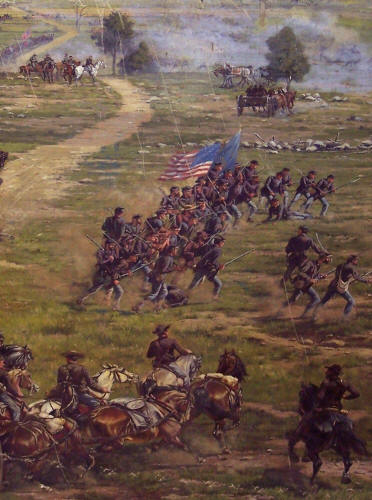
Laster's Fine Arts & Antiques of Winston-Salem, NC is very proud to announce a rare opportunity to own one of the most important National Historical Art Treasures of all time, the famous “Battle of Gettysburg Cyclorama.” One of only two surviving examples of Paul Dominique Philippoteaux’s huge circular panoramas of this decisive Civil War battle depicts “Pickett’s Charge” on July 3, 1863. This battle is often termed the “High Point or High Water Mark of the Confederacy.” Confederate General Robert E. Lee boldly led his courageous Southern Army deep in Northern territory. They were met explosively just outside Gettysburg, Pennsylvania by the Union Army of the Potomac, commanded by General George G. Meade. This was to become the bloodiest battle of the war for both sides. Over 45,000 casualties were suffered in the three-day battle which caused a turning point in this terrible war.
This painting is a breathtaking monumental work of oil on canvas in a series of fourteen panels totaling 376 feet in length, 22 feet in height and six tons in weight. It has a remarkable provenance from its first exhibition in Chicago in 1883, to its rediscovery in 1965, to the present owners who purchased it from Wake Forest University.
A Chicago businessman, Charles L. Willoughby, commissioned 34-year-old Philippoteaux to paint the panorama after hearing of the great success and appreciation of Philippoteaux’s Panoramas in other countries. Willoughby arranged for him to visit Gettysburg, where he spent several months in 1880. Philippoteaux was introduced to Union General Hancock, a leader and survivor of the battle, who recounted accurate details of the fight. Under General Hancock’s direction on the battlefield, Philippoteaux sketched, photographed and marked with precision the various points of encounter of the rival forces over the entire area. Philippoteaux also consulted the official maps on file in the War Department in Washington, DC. He was also advised by other Union Generals Hunt, Webb and Doubleday and the authors Carleton Coffin and Barnet Phillips. Satisfied with all of the information, Philippoteaux returned to Brussels to begin his painting. For the next two years he worked with sixteen other artists to complete this feat. Philippoteaux said himself that Gettysburg was “The greatest effort of (his) life, and surpassed all (his) other works in truthfulness, coloring and nicety of detail.”
Upon completion, Philippoteaux returned to Chicago with the painting. It opened to the public on October 22, 1883, at the corner of Wabash Avenue and Hubbard Court. Well over half a million people viewed it during the first year of exhibition. Crowds flocked to Panoramic viewings during the latter part of the 19th century, and their popularity created great profits. “The Battle of Gettysburg” was immensely profitable.
After the Columbian Exposition concluded in Chicago in 1893, the Gettysburg Cycloramas were exhibited with great success in eight other major U.S. cities. This great work returned to Chicago for its final public display in 1933 at the Century of Progress International Exposition. At the Expo’s end, the great masterwork was rolled up and stored in a warehouse, where it remained for over thirty years.
This is one of two existing of as many as nine Gettysburg Cycloramas painted by Philippoteaux. The other surviving example, which was originally painted for Boston, is on permanent exhibit at Gettysburg, Pennsylvania. In 1944, while believing the first edition to have been destroyed, Congress designated the second edition as a National Historic Object.
In 1965, world-renowned artist Joseph Wallace King, also known as “Vinciata,” rediscovered our nearly-forgotten treasure. Behind a smoke-stained block wall which had survived the warehouse’s fiery destruction, King discovered the fourteen giant canvas rolls. We can only imagine the great thrill Mr. King experienced after convincing the warehouse owner’s son to let him knock a hole in the wall and peer inside.
Mr. King purchased the painting and brought the work back to his home in Winston-Salem, North Carolina. He had each great canvas unrolled on the Bowman Gray football field, but needed to remove the goal posts at either end of the field for full display. The painting was seventy-six feet longer than the field.
He kept the painting in storage for several years, and upon his 1996 death, it was willed to Wake Forest University.
In March of 2007, a North Carolina investor group purchased the painting from Wake Forest University. For over ten years, the University professionally maintained and cared for the painting while proudly serving as steward to this great work.
Laster's Fine Art & Antiques has been contracted as the exclusive agent for the investors to market this highly-important monument of American history. Please call or write for more photographs and information. --- AS OF 7/15/2010: ON RESERVE FOR PROSPECTIVE BUYER --- |